


September 2026
Muir AI Named a Winner in the World Economic Forum's (WEF) AI for Resilient Supply Chains Challenge




Thank you for registering


July 2026
Muir now connects natively to MCP-compatible enterprise AI. The result is that Muir's data and modeling capabilities are scaled across your team, powered by your AI and native to your workflow.
Looking to subscribe to our newsletter? Click here.
Every Muir model has always held more than any person reads. A full teardown carries the material, mass, process, origin, price, and emissions basis for every node in the hierarchy, thousands of data points on a single product, multiplied across a portfolio. The questions that cut across that structure, how much of one material sits in the whole build, which lines share an upstream supplier, were answerable in principle and rarely asked in practice, because each one cost hours of manual traversal.
With our MCP connection, any question can now be asked. A design engineer can price a material or geometry change at the moment of selection, while it can still change the outcome. A buyer can pull a negotiation-grade should-cost position on any line in the BoM, not just the lines someone had time to study. A sustainability lead can query the carbon basis of the same model, in the same conversation, as the cost questions. None of these are new capabilities of the model. They are questions the model could always answer, finally easy enough to ask.
The deeper change is what happens after a question is answered. The assistant is given the same ability to leverage Muir's models as a user. Agents can review any model, test hypotheses, rank the cost-reduction levers by impact, quantify the supplier switch, check whether the team has already explored the same direction, and assemble the result into a scenario the organization can act on.
The user has final say, choosing which lever to pull and supplying the expert edits the model cannot infer, while the agent handles the breadth no person can. That accelerates a shift we have written about before: from producing the number to deciding what the company does with it. The difference now is that the number gets produced across the entire model at once, with the reasoning attached.
The MCP connection is a permissioned interface to Muir, not an export of it. The assistant retrieves only what you ask for, and every request is scoped by the access controls your workspace already enforces. Muir stays the system of record. Every value in a Muir model carries provenance, so the assistant's answers trace to their basis: what the source declared, what the system generated, what a human edited. Every write follows the propose-validate-preview-apply path shown in the video, so no model changes without an explicit, attributed decision. And the platform behind the connection is SOC 2 Type II certified.
The assistant is a new interface. The rigor underneath it is unchanged.
The Muir MCP connection is available to select Muir customers today. Setup takes minutes: connect the Muir MCP server in your assistant's integrations, authenticate against your Muir workspace, and every model your team has built is in the conversation.
If you want to see it live on one of your own products, from a photo or a raw BoM to a sourcing scenario in a single conversation, book a demo.
Every Muir model has always held more than any person reads. A full teardown carries the material, mass, process, origin, price, and emissions basis for every node in the hierarchy, thousands of data points on a single product, multiplied across a portfolio. The questions that cut across that structure, how much of one material sits in the whole build, which lines share an upstream supplier, were answerable in principle and rarely asked in practice, because each one cost hours of manual traversal.
With our MCP connection, any question can now be asked. A design engineer can price a material or geometry change at the moment of selection, while it can still change the outcome. A buyer can pull a negotiation-grade should-cost position on any line in the BoM, not just the lines someone had time to study. A sustainability lead can query the carbon basis of the same model, in the same conversation, as the cost questions. None of these are new capabilities of the model. They are questions the model could always answer, finally easy enough to ask.
The deeper change is what happens after a question is answered. The assistant is given the same ability to leverage Muir's models as a user. Agents can review any model, test hypotheses, rank the cost-reduction levers by impact, quantify the supplier switch, check whether the team has already explored the same direction, and assemble the result into a scenario the organization can act on.
The user has final say, choosing which lever to pull and supplying the expert edits the model cannot infer, while the agent handles the breadth no person can. That accelerates a shift we have written about before: from producing the number to deciding what the company does with it. The difference now is that the number gets produced across the entire model at once, with the reasoning attached.
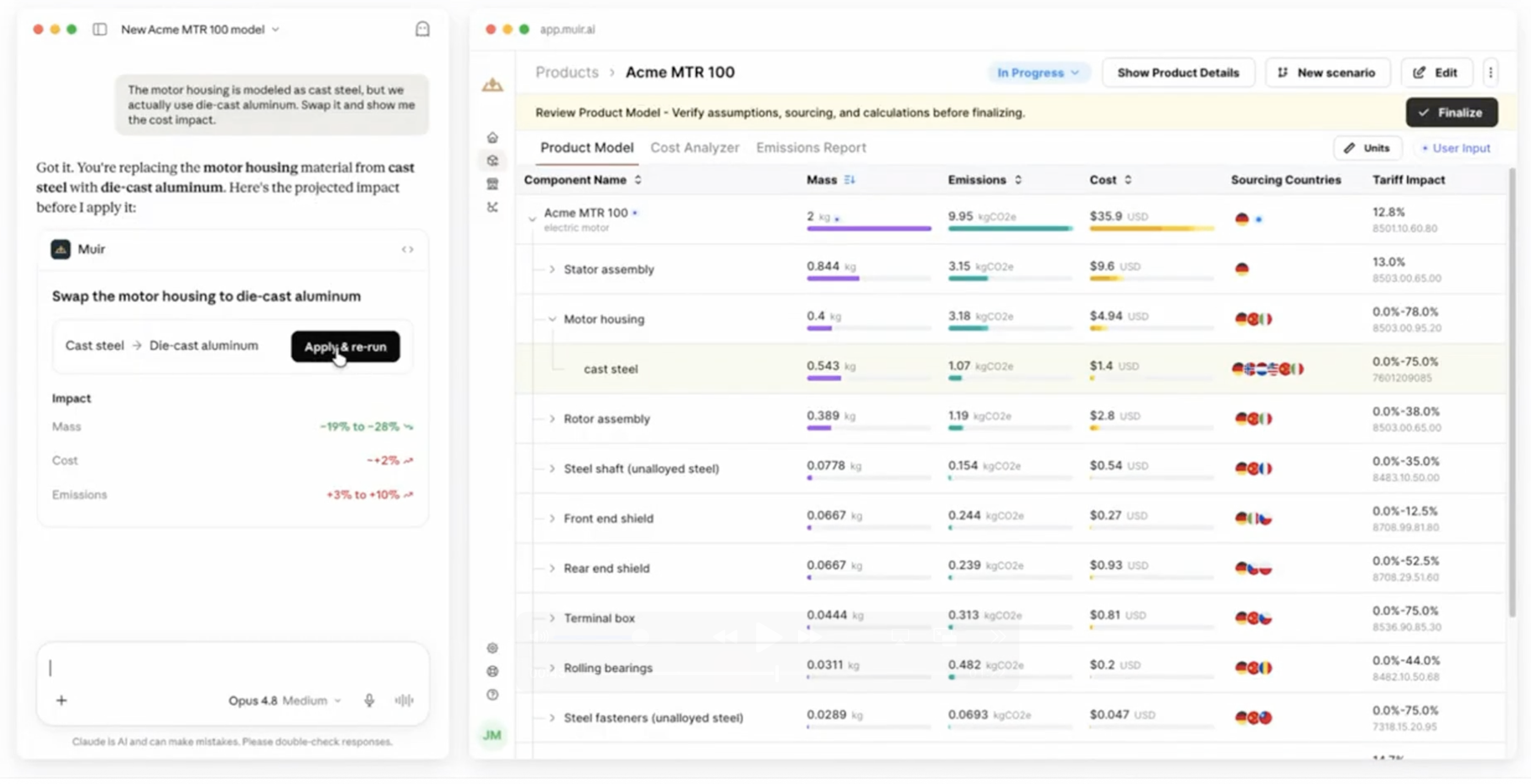
The MCP connection is a permissioned interface to Muir, not an export of it. The assistant retrieves only what you ask for, and every request is scoped by the access controls your workspace already enforces. Muir stays the system of record. Every value in a Muir model carries provenance, so the assistant's answers trace to their basis: what the source declared, what the system generated, what a human edited. Every write follows the propose-validate-preview-apply path shown in the video, so no model changes without an explicit, attributed decision. And the platform behind the connection is SOC 2 Type II certified.
The assistant is a new interface. The rigor underneath it is unchanged.
The Muir MCP connection is available to select Muir customers today. Setup takes minutes: connect the Muir MCP server in your assistant's integrations, authenticate against your Muir workspace, and every model your team has built is in the conversation.
If you want to see it live on one of your own products, from a photo or a raw BoM to a sourcing scenario in a single conversation, book a demo.
It is a native integration built on the Model Context Protocol, an open standard for connecting AI assistants to external platforms. It lets assistants like Claude call Muir's live capabilities as tools: building product models, interrogating them at full depth, proposing edits, and using agentic capabilities to review outputs and recommend product strategies, all from a plain-language conversation. The connection is currently in beta and is rolling out to select Muir customers.
Any MCP-compatible client, including Claude and Claude for Enterprise. Because MCP is an open standard adopted across major AI platforms, the connection is not tied to a single vendor; it works with the enterprise assistant your organization has already approved. During the beta, access is enabled per workspace as customers are onboarded.
No. Every write follows a propose, validate, preview, apply path. The assistant surfaces the full impact of a proposed change, in cost, mass, and emissions, and nothing is committed until a user explicitly applies it. Every change is attributed, and every value retains its provenance.
The MCP connection is a permissioned interface that returns the results of specific, authorized queries; it is not a bulk export or a training pipeline. The connection inherits your workspace's existing access controls, and the platform is SOC 2 Type II certified.
The assistant can review a model's full output, thousands of data points across materials, processes, and sourcing, then rank cost-reduction levers by impact, quantify supplier-switching scenarios, surface related analyses your team has already run, and assemble the result into a saved scenario. It recommends rather than decides: every change to the model still requires an explicit, attributed approval.

Don't worry, we don't spam.


Understand cost, navigate tariffs.

Drive deeper intelligence into product design cycles.

Scaled PCFs and reduction insights.

Determine your full supply chain and its cost.

Baseline your footprint and decarbonize.
Building Product Intelligence.
Find open roles at Muir.
Muir has plans for any scale.


