Contact us

Thank you for contacting us!

Your submission has been received and we'll be in contact with you shortly.

Return home
Oops! Something went wrong while submitting the form.
Solutions

Build Confidently With Real Cost Intelligence

Understand the cost of your goods and find hidden savings
Header image

Trusted by top companies

Should Cost Modeling

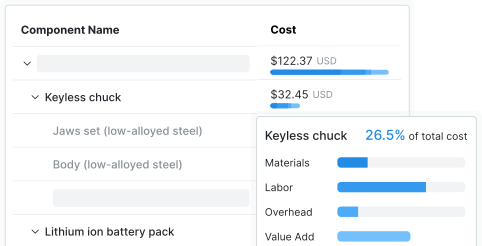
Break down total cost into materials, labor, overhead, and value-add

Muir decomposes every component into its core cost elements, materials, labor, overhead, and value-add, so teams get instant visibility into what they should be paying and where cost savings exist.

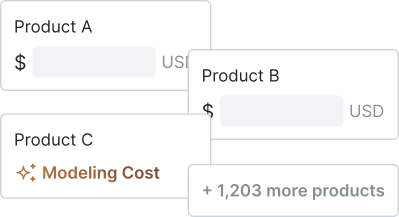
Scaled cost models for every design

Traditional cost estimates rely on manual processes and are often limited in scope and scale. Muir’s automated process means you get a cost model for any product design, from concept through procurement, without requiring supplier input or tedious tear downs.

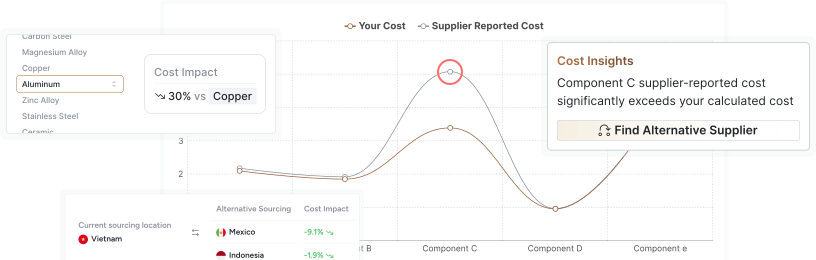
Scenario planning to understand cost trade-offs

Evaluating alternatives is nearly impossible when cost implications aren’t clear. Muir lets you simulate sourcing, material, design, and supplier while also providing its own recommendations to instantly see how each scenario reshapes your overall cost structure.

Why Muir

Case Study

Manufacturer exploring the development of a new regional value chain
As the team evaluated a new regional value chain, they quickly narrowed viable suppliers by modeling labor, materials, overhead, and trade exposure. This eliminated uncertainty around true landed cost and enabled 10× faster build-vs-buy and sourcing analysis, leading to a short list of suppliers aligned with both near-term economics and long-term resilience.
10x
faster sourcing and build-vs-buy analysis
Eliminated uncertainty
clear understanding of new value chain cost and drivers
Identified ideal suppliers
while considering labor, overhead and materials

Better decisions
start with clear product intelligence

Frequently Asked Questions

How does AI calculate a "should-cost" estimate from a Bill of Materials?
Once a BoM is established, AI leverages massive datasets to price out individual components. Muir combines our proprietary cost database, real-time market metrics, and predicted manufacturing processes to provide a highly nuanced product cost estimate. This gives you a granular breakdown across raw materials, labor, overhead, and value-add processes.
How do Muir should-cost models improve supplier negotiations compared to traditional benchmarking?
Traditional benchmarking often relies on static, outdated data or missing price targets. Muir provides a transparent, dynamic cost breakdown. Instead of just negotiating a total price, procurement teams can enter discussions with data-backed "target costs" for specific sub-components, identifying exactly where a supplier's quote is misaligned with current market realities.
How do Muir should-cost models account for market volatility and raw material price fluctuations?
Static cost models quickly become obsolete when commodity prices shift. Muir solves this by integrating dynamic market metrics and maintaining up-to-date cost databases directly into the AI engine. Rather than relying on historical quotes, Muir's system is continuously kept up to date to reflect current raw material costs, ensuring your "should-cost" targets remain accurate during periods of market volatility and inflation.
Can AI estimate manufacturing labor and overhead costs across different global regions?
Yes. A true cost estimate must reflect the realities of local manufacturing. When Muir calculates a should-cost model, it applies region-specific data for labor rates, efficiencies, upstream trade behavior and currency impacts. Because the platform analyzes your sourcing footprint, users can easily run scenario models to instantly compare the total cost of manufacturing a component in Mexico versus Vietnam or the United States.
Does the AI cost model include specific manufacturing processes and value-add costs?
Absolutely. Material cost is only one piece of the puzzle. Muir’s Synthetic BOM engine doesn't just predict what a product is made of; it predicts how it is made. The AI determines the necessary manufacturing processes (e.g., injection molding, CNC machining, stamping) to then derive both labor and overhead costs, as well as the associated "Value Add" of the finished product.
How can I estimate product costs during the New Product Introduction (NPI) phase without final CAD files or BOMs?
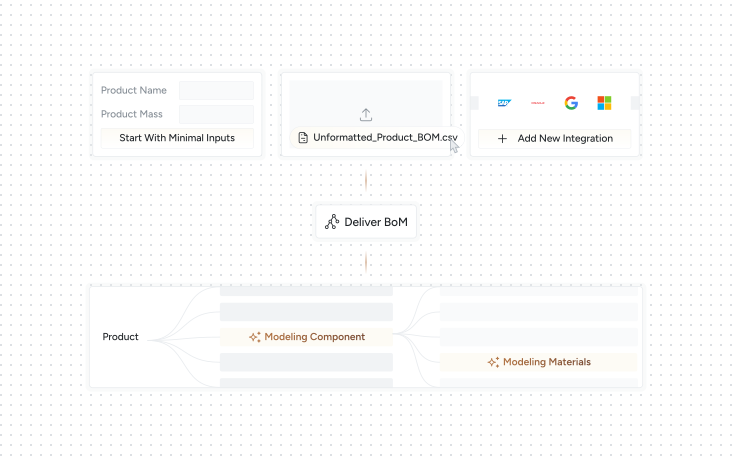
Traditionally, cost engineers wait for final engineering drawings to build a quote. Muir accelerates the NPI process using its Synthetic BOM technology. By inputting basic parameters, like a product description, target mass, and likely supplier region, Muir’s AI can reconstruct a highly probable material composition and cost model. This allows engineering and procurement teams to establish realistic target costs months before the final design is locked and then iterate as the design matures.
What types of commodities, components, or product categories can Muir's AI analyze?
Muir is designed for flexibility across complex supply chains. Because the platform leverages vast, proprietary datasets and industry standards rather than rigid templates, it can model a massive variety of SKUs. Whether you are analyzing complex mechanical assemblies, electronics, or obscure sub-components, the AI adapts its cost and classification models to fit the specific nuances of that product category.
What is a Synthetic Bill of Material (BoM) and how does Muir generate it without supplier inputs?
A Synthetic BoM is an AI-generated approximation of a product's material makeup and manufacturing processes, used when primary supplier data is missing or incomplete. Muir’s BoM engine is built on our proprietary materials and manufacturing dataset. Combined with AI search, it takes simple procurement data (product name, mass, and supplier) and reconstructs the likely material composition for a product. This allows engineers and supply chain teams to instantly analyze thousands of SKUs without waiting for vendor quotes.
Is my company’s proprietary data secure when using Muir?
Yes. Enterprise AI tools must ensure your data is never used to train public models. Muir employs enterprise-grade security, including SOC 2 Type II compliance and data encryption at rest and in transit. Your proprietary data remains completely siloed and accessible only to your authorized users.
Can Muir integrate with existing ERPs like SAP, Oracle, or NetSuite?
Yes, Muir offers API-based integrations and bulk-upload capabilities that ingest data directly from your existing ERP or PLM systems. Because our AI is highly flexible, it eliminates the need for manual data cleaning and can easily handle obscure part numbers, messy data, or incomplete BoMs.
How does a "Human-in-the-Loop" process improve AI-generated product insights?
While AI automates heavy data processing, "Human-in-the-Loop" ensures accuracy by keeping subject matter experts in control. Muir believes in transparent AI; every classification, footprint, or cost model we generate includes the underlying logic and source data. This allows your cost engineers or sustainability professionals to verify, override, or fine-tune results. Refinements are then stored so your organization can reference the updates in the future.
How do you pronounce Muir?
Don't worry, we have all been there! For those struggling to say Muir, it rhymes with pure.