


September 2026
Muir AI Named a Winner in the World Economic Forum's (WEF) AI for Resilient Supply Chains Challenge




Thank you for registering


May 2026
We're shipping major updates to the Muir platform. The new homepage looks good, but that's not all. Scaled BoM inputs, deeper manufacturing modeling and Supplier Search are built to accelerate and increase the impact of our customers.
Looking to subscribe to our newsletter? Click here.
Supply chains are chaotic right now. That's not news to anyone running one. What is new is the pace. Tariff regimes shift, sourcing assumptions break, a supplier in one geography becomes a liability overnight, and the cost model someone built last quarter is already wrong.
The teams trying to manage all of this keep telling us the same three things:
The new release is the answer to that. The arc is simple: get from a BOM file to actionable cost and emissions intelligence in minutes.
You upload the file. That's the input. Whatever shape it's in.
Muir helps map the columns, flags the data quality issues, and gets you to a working model. No manual cleanup, no consultant onboarding, no hours spent in Excel. The point is to remove the on-ramp entirely. If the BOM is the input you have, the BOM is the input we'll take. On top of that, we flag errors and gaps as we process the fill; you either clean those up yourself or let our modeling handle it for you.
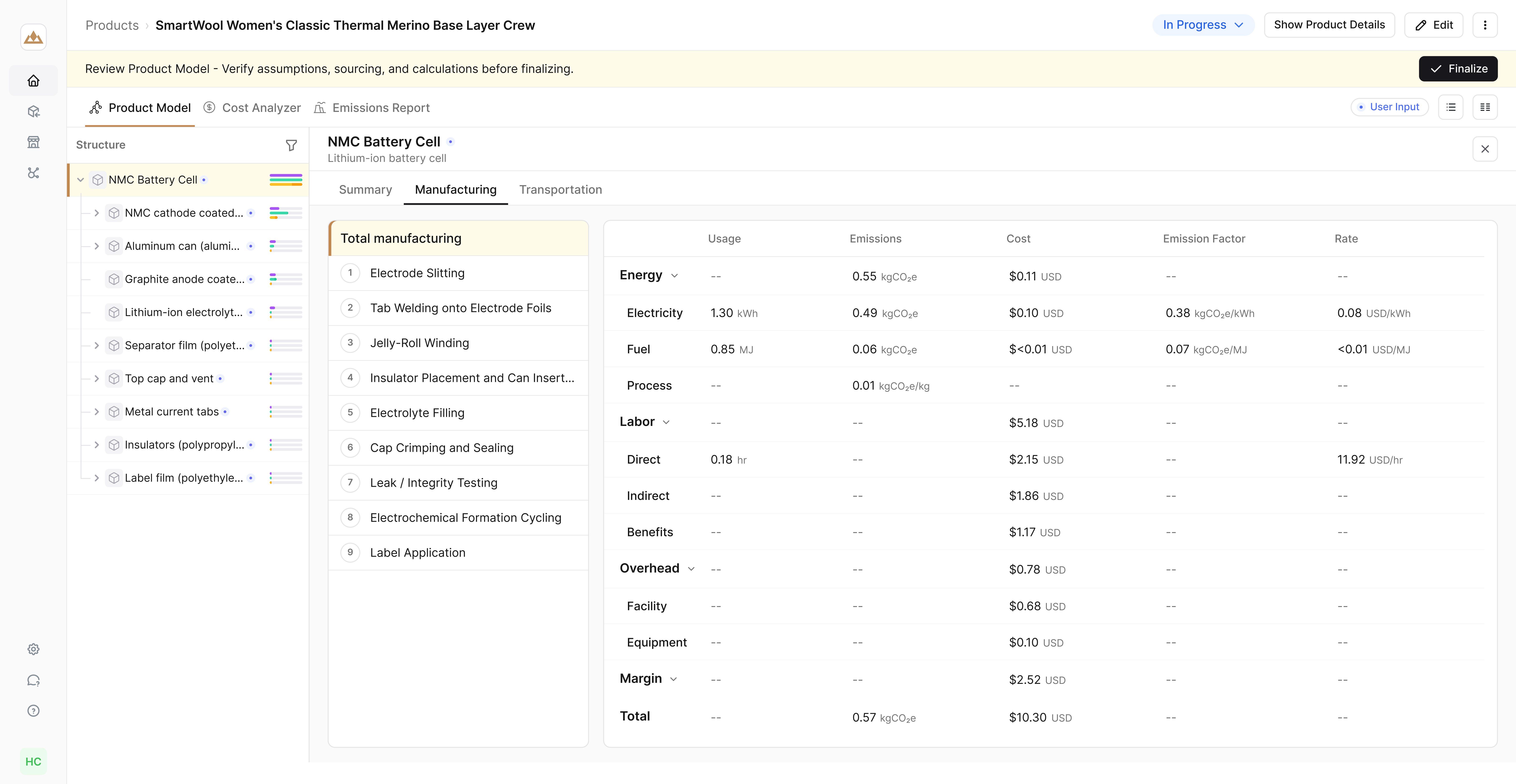
Once the model is built, you can see every dollar.
Energy, labor, overhead, and margin broken down across every step of manufacturing. See how every step in your product's transformation impacts your bottom line.
This is the part cost engineering teams care about most: not a single rolled-up number, but a decomposition they can act on. If overhead is the problem, you can see it. If a process step is driving the emissions footprint, you can see it. And because the model is generated in minutes, you can continually run it from design through procurement — making the best decisions throughout the lifecycle.
Just as important, every output is editable. Adjust labor hours, layer in a new processing step, refine an assumption, any detail of the model can be changed. Because in the end of the day, that's what it is: your model, your scenario, your product.
Knowing what to change is half the job. Knowing who to do it with is the other half.
Our upgraded Supplier Search closes that gap. We find suppliers for your products considering supplier size, product fit, and whether the supplier is a manufacturer or a distributor. The shortlist you see is one you can act on, not one you have to filter down. Explore standalone scenarios, or based off Muir's recommendations for a modeled product. With Supplier Search, you can move from "here's the change worth making" to "here's who can make it" in one step.
The teams we work with — across electronics, industrial, and chemical manufacturing — are not asking for more dashboards. They're asking for tools that let them answer real questions on the timeline the business is actually operating on.
What does this product cost if we move final assembly? What happens to our PCF if we substitute this material? Where is our tariff exposure concentrated, and what's the cheapest way to reduce it? Those are the questions, and they need to be answerable in an afternoon, not a quarter.
That's what real product intelligence looks like. Not better reports. Faster, earlier, more decisive answers.

Don't worry, we don't spam.


Understand cost, navigate tariffs.

Drive deeper intelligence into product design cycles.

Scaled PCFs and reduction insights.

Determine your full supply chain and its cost.

Baseline your footprint and decarbonize.
Building Product Intelligence.
Find open roles at Muir.
Muir has plans for any scale.


